CESAPI - deadly sanctions
on Iraq
See => more on humanitarian crisis due to war. .
The UN Sanctions
The UN Security Council imposed the sanctions on Iraq after Iraq
had invaded Kuwait in 1990 and these sanctions are to continue until
the UN Special Committee has verified that Iraq has no more weapons
of mass destruction. Since then the sanctions have been renewed
through several UN Security Council Resolutions.
Effects of the Sanctions
According to the UN , over 1.2 million Iraqis had died as a result
of the sanctions as of June 1997, this is a tragic statistic. However
the effects of sanctions permeate the whole of the Iraqi society.
The following quotes from UNICEF's “The Situation of Children
in Iraq 2002” illustrate this:
-
"many Iraqis live on as little
as $3 to $6 a month" pg.1
-
"A study carried out in May
2000 showed that close to half of children under five suffered
from diarrhea within two weeks of that month; over a third of
the children suffered from acute respitory infections; and nearly
half suffered from fever." pg. 21
-
"[S]afe drinking water is now
a nation-wide problem." pg 23
-
"The state of many of the schools
in Iraq is not just a disincentive to education but also a public
health hazard for children." pg. 25
-
"...more than half of pregnant
mothers are anemic, due to inadequate food intake in terms of
both quality and quantity." pg. 27
-
"As there has been no major change in government in Iraq
since 1978, one can only conclude that if the Government had
had the resources, it would have invested in social services,
as in the past. This erosion of human development ... therefore
appears attributable to the lasting effects of the crises of
1990/91 including the resulting sanctions regime..."
-
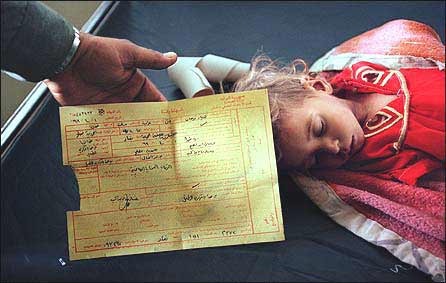
A victim of the UN sanctions - 2 year old Nenya after she died from
meningitis. According to one doctor "A 50 cent tube could have
saved the child's life, but the hospital has none." According
to another doctor the tube is "impossible to obtain under the
sanctions.". Dan DeLong Seattle Post-Intelligencer. Open sewage
is a common sight in Iraq now. Parts to repair and maintain the
sewage lines and water treatment plants have been denied by the
UN sanctions committee and the medicine which would cure the water-borne
diseases is largely unobtainable. This is one of the reasons why
there is such a high child mortality rate, 200 daily according to
UNICEF.
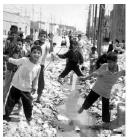 Children
playing open sewage drain. photo by I MacInness Baghdad 1999 Children
playing open sewage drain. photo by I MacInness Baghdad 1999
|