


|
|
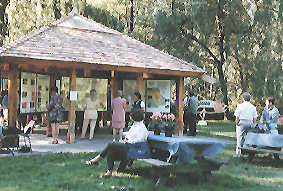
WILLIAMS PARK INFORMATION KIOSK This kiosk houses a self-guided educational tour of the watershed. It provides relevant information about watershed components and processes. It also introduces the public to the concept of watershed stewardship. All members of the SRWMP have posters on display at the kiosk.
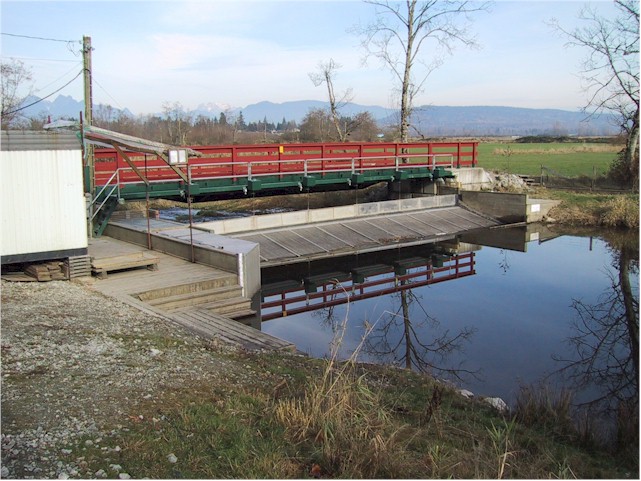
FISH COUNTING FENCE The Salmon River Fish Counting Fence was built near the corner of Glover Road and Rawlison Crescent. The land adjacent to the fence is part of a family farm and a lease agreement was reached with its owners which allows Fisheries and Oceans Canada (DFO) to use the site in return for providing bridge access for cattle to hay fields across the river. The basic fence is an adjustable aluminum "rake-like" weir that reaches the bottom and spans the width of the river. When used to capture returning adult coho salmon, the rake fingers are half immersed and direct fish through a "funnel" and into a box trap. Afterwards, those fish are measured, counted and some of them are tagged (this is done to evaluate the reliability of the marking methods used estimate fish abundance). For capture of downstream migrating juveniles in spring, the weir is fully immersed and covered with �" plastic mesh. The mesh keeps the small fish from passing between the fingers of the weir and helps direct them into a box trap
and side abutments. All structures were constructed from 2x6 lumber on dry land and then placed and backfilled with granular crushed rock. Because of the extremely soft clay/silt substrate at the site, additional rock was used to stabilize the riverbed immediately upstream of the fence. A fry proof net, coffer dam and a diversion channel isolated the instream work area from the river flow during the construction phase. A number of additional features such as power, lights, decked work areas, gravel parking area and secure storage/work area were added to the fence to improve the conditions under which staff operates and maintains the fence, captures and handles fish and, last but not least, collects the valuable biological information the fence was built for in the first place.If you are in the vicinity of Fort Langley during May or early June visit the fence to observe and learn how juvenile coho salmon are counted by the DFO�s stock assessment staff and adult Steelhead trout are moved past the weir by members of the Salmon River Enhancement Society. If you visit the site in late November � early December do not miss the chance to witness how adult fish are handled and marked in their upstream spawning migration. Check out article
Heading Upstream
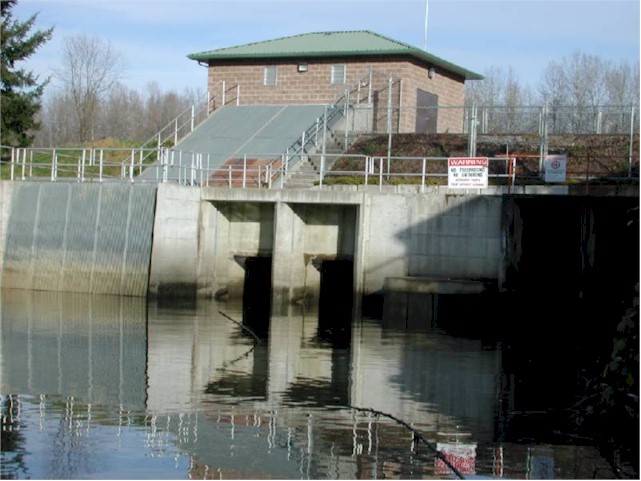
Salmon River pump The new screw pump installed one year ago to pump the Salmon River flow up into the Fraser would theoretically allow an adult steelhead to escape unharmed but it is unlikely that the adults would enter the water intake due to the noise of the pump. The DFO trap also prevents the steelhead from going downstream, offering an opportunity to net them at the trap and transport them to the Fraser.
With the installation of the screw pump, adult coho, cutthroat and rainbow returns this fall and winter should be improved, adding to the Salmon River's existing position as the most productive river in the Lower Mainland for coho and cutthroat. |